Record · Understand · Practice
Team shot statistics
Learn what 0–4 grades mean, track your team’s shots and turn the numbers into a practice plan.
Start your team shot log
A clearer plan. A calmer call.
You don’t need a speech for every shot. You need a plan your team understands.

Record · Understand · Practice
Learn what 0–4 grades mean, track your team’s shots and turn the numbers into a practice plan.
Start your team shot logEvery position · Every level
Reset after a miss, work with nerves and keep team communication useful when a game gets tense.
Explore the mental-game guideBuild the team. Learn the sheet.
Choose people to grow with, agree on a season, and build clear team communication.
Download printable PDFCompare paths, spot changes and record what your team sees.
Download printable PDFCompare stones carefully, explore fictional sample records and keep your own notes.
Download printable PDFNew to skipping, or ready to think a little deeper? Start with the score and hammer. Work toward shot choices, useful misses and the skills your team needs. These are club learning tools, not an official coaching qualification.
Eight interactive challenges: read the turn, move the brush, choose a goal and compare practice records.
Play the sweeping gamePrint it. Bring your team.
Work through practice situations, choose a call, sketch a plan and discuss what happened. Every practice page includes a blank curling house for your team’s notes and stones.
Includes drills, reusable worksheets and facilitator discussion notes. Print the pages you need or use the whole workbook with your club.
Download the club workbook · PDFMake your ice time count
Choose a skill, two, four or eight players, and 30, 60 or 90 minutes. Get a printable plan with drills, rotating roles and room for notes.
Build a practice planYour call. Then the next stone.
Follow all 16 stones in one worked example. Make a call at three key moments and compare the reasoning with Granite.
Step through an endStart here
Read the house, choose a realistic shot and give your teammates a clear target. A good call includes what happens if it is a little off.
Read the basic skipping guide →Do you want to build a score, force one or create a steal? Start with hammer, then adjust for the score, end and stones in play.
Explore hammer decisions →Center guards, corner guards and open paths create different opportunities. Think about the reply as well as your own stone.
See two starting patterns →Protecting a lead and chasing points often call for different risks. Decide what result helps you before choosing a favorite shot.
Look at late-game choices →A partial make can still win. Compare the results of two calls, then ask how often your team gets each result.
Try the decision calculator →Spot a useful alternative while the stone moves, make a clear call, and recognize when the whole end needs a new goal.
Learn Plan B and bailing out →Use the simulator’s illustrated examples to discuss targets, contact and the result you want. It is a learning aid, not a prediction of real ice.
Open the shot simulator →06 · Read the shot as it happens
A stone is light, heavy or off line. Recognize the change, find a useful result that is still reachable, and tell the team quickly. This is a team skill: the sweepers judge weight while the skip or acting vice watches line and possible contacts.
Before delivery: agree on the target, a useful miss and the danger. “We want to draw behind that guard. If we’re short, a guard here can still help.” The backup must fit the score and stones remaining. A guard that helps early may achieve nothing on your final stone.
Sweeper: “Too light for the house.”
House: “Plan B, guard this side. Off.”
Sweeper: “Guard weight.”
House: “Good. Keep watching.”
This is one example. It does not mean every light stone should be left unswept.
These are fictional teaching situations. Choose the call for the actual path, weight, ice and team.
You are building a steal with more stones to come. The intended draw cannot reach the house, even with realistic sweeping. Its line can still protect a useful route.
New job: finish as a guard that helps the next shot.
Possible call: “Plan B, guard. Off.” If it needs help reaching the chosen guard zone, call for weight instead.
Check: What does it protect? Does it block your own next shot? Don’t abandon a draw the sweepers can still reasonably bring in.
With hammer, you wanted a corner guard while building two. The stone has enough weight to enter the house. There is an open route to a useful position on the side.
New job: keep a potential scoring stone without creating a damaging contact.
Possible call: “Plan B, keep it on the side. Sweep for line.” Use this only if holding the line helps and the projected weight still lets the stone remain in the house.
Check: Sweeping for line can add distance. “Heavy” does not automatically mean “Off,” but don’t sweep a useful stone through the back.
You wanted to draw behind a guard. The stone is wide and a little light. The buried target is no longer realistic, but sweeping could bring it into the open side of the house.
New job: keep a usable stone in the rings, accepting that it will be exposed.
Possible call: “Plan B, open side. Sweep for weight.”
Check: Compare that with a short finish. An exposed counter may help, but it could also give the opponent backing or an easy hit. Curling Canada’s coaching manual discusses this line-versus-weight tradeoff.
Sweeping can influence distance and curl. It cannot send the stone to any target you choose. You cannot undo earlier sweeping, and stopping does not apply brakes. A fast takeout that completely misses its target may have no useful recovery.
Use permitted techniques. World Curling prohibits techniques intended to slow a stone. Don’t improvise a braking method or assume one sweeping side always produces the same result.
Sometimes the best Plan B prevents a worse contact. Sometimes there is no useful save. Keep the call calm, then plan from the actual result.
With a club instructor, use comfortable draw-weight shots and agree on two possible finishing zones. The caller identifies when the original target becomes unrealistic, names the backup and gives one clear instruction.
Judge the communication and decision as well as the finish. Review team communication and directional sweeping.
An in-motion backup changes this shot. Bailing out changes the result you are working toward for the end. Reassess after every delivery, especially when a miss or strong reply closes a route. There is no universal “bail after this stone” rule.
If getting two now requires a difficult sequence and risks your last scoring route, one may become the priority. A blank is worth considering only if clearing all scoring stones is realistic and retaining hammer helps under your competition’s rules. A crowded house does not become easy to blank just because you want out.
Team phrase: “Two is getting expensive. We’re working for one. Keep that draw route available.”
If your protected stone is gone and the opponents have separated counters, another guard may only help them. Compare removing a threat with drawing or freezing closer than their second counter. Try to make them work for one; if that is no longer realistic, limit the larger threat.
Team phrase: “The steal has faded. Watch their second counter. This shot’s job is to reduce the damage.”
A simple reset: “Our new goal is ____. This shot’s job is ____. We can accept ____. We must avoid ____.” Confirm target, turn, weight and sweeping plan.
Learn the game. Love the game.
Your quarterback-style reminder
Score. End. Hammer. What do we need? What is the useful miss? How much time is left?
One printable page with two panels to cut or fold. Keep it beside your practice sheet, in your bag or laminate it for the season.
Download the quick card · PDFThree illustrated situations: tied, down one and up one. Includes worked examples, team observation sheets and a plan for checking your estimates.
Download the 12-page pack · PDFA curling “Moneyball” pilot
This calculator explores the first card in the pack. Change the estimates and see when the preferred call changes.
Standard four-player curling. This is the last stone of the scheduled final end; the opponent has no reply. Our A1 stone is four feet right of the tee. Their O1 stone is two feet in front of the tee and is shot stone. There are no guards or other stones.
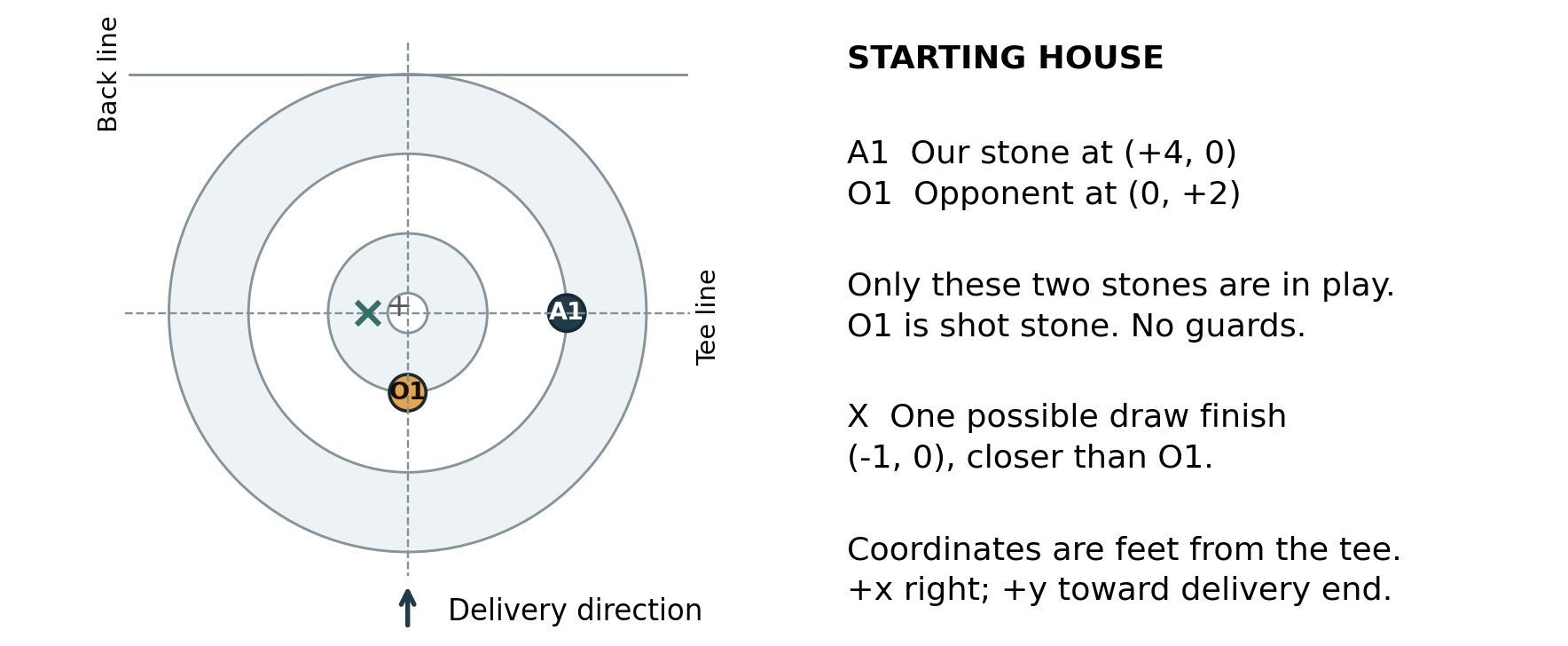
Full: finish within one foot of the tee, clear of O1. We score one and win.
Useful partial: miss that target but still finish closer than O1. We score one and win.
Miss: O1 stays closest. We lose.
Full: remove O1, keep the shooter in the house and leave A1. We score two and win.
Useful partial: O1 and the shooter go out; A1 stays. We score one and win.
Miss: O1 stays shot stone. We lose.
Model limits: draw branches assume no contact; hit branches preserve A1. Unexpected contacts, blanks or tied measures need additional branches. Record them rather than forcing them into a convenient label. “Full” and “partial” describe these particular targets, not official shooting grades.
Because a useful partial can still win. Compare every outcome and its value, not just perfect shots.
No. It only follows from these invented inputs and this simplified house. Change the estimates or the possible outcomes and the answer can change.
Small samples and changing ice can easily outweigh a small modeled difference. Treat it as uncertainty, not a precise ranking.
A second decision: value the result
An easier shot can keep you playing. A harder shot can win right now. Compare the chance of winning the whole game, including what happens after a tie.
Standard four-player curling. You trail by one and are delivering the final stone of the final regulation end. The opponent has no reply in this end. Score one and you go to an extra end without hammer. Score two and you win immediately.
A conditional outcome model: assume a coach has checked that both calls are available on the actual layout and that the branches below describe their possible results. This tool does not simulate stone paths or guarantee that a particular house offers these shots. Blanks, tied measures, other scores or unexpected contacts need different branches. Do not force those results into this example.
With the starting estimates, the draw wins the game 90% × 25% = 22.5% of the time. The double’s tie branch adds 25% × 25% = 6.25%. Its outright-win branch therefore needs another 22.5% − 6.25% = 16.25% to draw level.
Holding the draw’s tie rate, the double’s tie rate and the extra-end estimate fixed: break-even score-two chance = (draw tie chance − double tie chance) × extra-end win chance. Multiply probabilities, so 90% × 25% means 0.90 × 0.25.
Changing a player’s technique may also change the partial and miss rates. Holding one branch fixed is a way to explore the decision, not a promise about real attempts.
In the starting example, the draw’s expected signed end score is +0.80 and the double’s is +0.55. But one point only ties this game. Two points win it. The harder call can have more game-winning value even while its average end score is lower.
Expected points and chance of winning answer different questions. Here we are trying to win an ordinary win/loss game.
Use comparable situations. Agree on the target and outcome branches before delivery. Record every attempt, including unusual outcomes, and keep sample size, player, turn, intended and delivered weight, ice conditions and sweeping context.
Compare your estimates with later attempts. Small samples, changing ice and different opponents can change the answer. A good call can still miss, and one successful shot does not prove a call was best.
If the opponent still has a stone to play, you must include their plausible replies. This final-shot example has none within the end; it includes the opponent’s extra-end strength only through your extra-end win estimate.
Playing the Numbers Game (Curling Canada, 2022, pages 44–45, PDF) is the article behind the “harder winner or easier tie?” discussion. It describes how coaches and teams use analytics; it is an article, not a controlled trial.
Renée Sonnenberg’s 2023 coach handout: Win Probability, Shot Difficulty & Video (PDF) gives practical questions and a recording framework. Its historical teaching rates are not this team’s estimates. Curling Canada’s 2023 training-camp report shows how teams combine situation-specific analysis and video.
These papers study different parts of the problem. Real match records, real stone layouts, simulated shots and robot matches are different kinds of evidence. None supplies the fictional percentages used in this calculator.
Keep the rules era and format in view. Older game data predate today’s five-rock and no-tick rules. Historical rates need checking before reuse. Four-player curling and mixed doubles also need different assumptions, including hammer transitions. Publication date alone does not make a model’s estimates suitable for your team.
Download the club experiment workbook
Six printable pages: set a repeatable draw-versus-hit test, record every attempt, and compare results cautiously. Blank houses included on each practice page.
Turn estimates into evidence
A lineup is more than four shooting percentages. Sweeping, communication, ice reading and the combination of skills matter too. This pilot helps you ask better questions; it does not identify an “optimal” roster.
HouseCall teaching pilot. Examples use hypothetical data. Source review: October 2026.
Make the plan clear. Give your teammates a shot they believe in.
Understand the equipment, develop a repeatable delivery and take a practice sheet to the club.
Download printable PDFFour-player decisions, no-sweeping tradeoffs, four fictional positions and a team worksheet.
Download printable PDFOne problem. One useful next step.
Heavy draws? Missed line? Mixed-up sweeping calls? Pick a problem for possible causes, one small drill and a lesson to explore.
Find help with a curling problem →