A practical guide for four-player wheelchair curlers: choose shots for your team, this ice and the score. Includes original discussion scenarios and a printable worksheet. Learn the game. Love the game.
Yes, strategy changes. The score, hammer, end and stones still shape the plan. With no sweeping, the team has to choose a shot whose path, stopping area and useful misses make sense before release. That can favor an attacking draw, a precise tap, a takeout or a guard. The right choice belongs to this team on this ice.
Start with the same game questions
Four players each deliver two stones per end, alternating with the opponent. Hammer means last stone. A team that scores gives up hammer for the next end; a blank retains it in this four-player game. [2]
What result helps us now: two points, one, a blank, a force or a steal?
How many stones remain, and what is the opponent likely to try next?
Which available shot gives our player a realistic route to that result?
Rule notes that change the conversation
World Curling wheelchair games are scheduled for eight ends. Delivery is from a stationary wheelchair; release must be before the delivery-end hog line. Sweeping is prohibited. [1: R14]
Five-rock free-guard-zone protection applies: during the first five deliveries, an opponent’s guard cannot be removed from play, directly or indirectly. The no-tick rule does not apply to wheelchair curling. A legal sideways move still has to respect free-guard-zone protection. [1: R6–R7]
What this guide covers
This is four-player wheelchair curling. Wheelchair mixed doubles has its own rules and starting positions; do not transfer these scenarios into that format. [1: R15, R17]
The decision framework, drills and fictional scenarios are original HouseCall teaching material. Rule notes are identified separately. Check your event’s rules and any club variations before play. Use the guide with your own teammates and coach; it is not an equipment or delivery-technique manual.
Choose for your team and your ice
Build a repertoire, not a stereotype
Wheelchair curlers have different strengths, experience and preferred shots. Coach Wayne Kiel emphasizes that each athlete has an individual process and skill set. Curling Canada’s pathway likewise uses individualized support. [3, 5] Make your tactical choices from what your players actually produce, rather than assuming every team needs a cautious game.
List the shots each player can call on now: guard, open draw, come-around, freeze, tap, hit-and-stay, hit-and-roll, peel or combination shot. Include both turns where relevant.
Describe the useful outcome, not just a perfect make. A removal that rolls out may still solve the problem; a beautiful draw to the wrong side may not.
Record recent practice and game evidence by player, turn, weight, path and stone. A small sample is a clue, not a permanent rating.
No sweeping: judge the whole landing area
HouseCall strategy: compare a shot’s useful area with the area your player has been reaching today. There is no sweeping adjustment to call for after release. A narrow draw may be entirely reasonable on a known path; a familiar hit may be the better choice on an uncertain one.
Short: does the stone become a useful guard, block our next path or fail to reach play?
Deep: is there useful backing, or will the stone leave a scoring chance or a double?
Narrow or wide: does it expose the counter, hit a guard or roll into danger?
Contact: what happens to every stone, including the shooter and any possible jam?
Delivery geometry belongs in your ice reading
Rule note: from the hack to the front edge of the delivery-end house, the stone starts on the centre line. From that edge to the hog line, its whole width starts inside the wheelchair lines. [1: R14(b)]
HouseCall strategy: use the player’s actual legal starting point and delivery line when choosing the aim. Do not assume a broom placement learned from a hack delivery, or from another teammate, describes the same path. Test both directions of play. Keep timing references consistent and label what was timed.
Aggressive and conservative are descriptions of choices, not descriptions of wheelchair curlers. Compare the reward, the likely misses and the next reply.
Make one clear plan before release
A short pre-shot conversation
1. Purpose: “We want a second counter,” or “We must remove one scoring stone.”
2. Options: name two realistic choices and the opponent’s likely reply to each.
3. Call: confirm turn, aim, weight, intended finish and any contact point.
4. Useful miss: name the side or depth that leaves the better position. Some shots have no comfortable miss.
5. Contingency: say what you will reconsider if the shot finishes short, deep, narrow or wide.
6. Read-back: the deliverer repeats the call and can flag a concern before committing.
Everyone contributes; one call stays clear
Agree who will do what before play. The person directing the house gives a single settled call. The deliverer confirms the intended shot and reports how the release felt. Teammates compare the observed path and finish with the call, and share concise, relevant information. These are discussion roles, not extra playing positions.
Rule note: during an opponent’s delivery, players take stationary positions behind the delivery-end back line; up to two may be behind the playing-end back line without interfering. [1: R14(c)]
Choose observation roles that fit legal positions. Nobody is assigned to sweep or to follow the stone to adjust it. Use agreed words or visible signals that the whole team can understand. Settle competing advice before the player begins the shot.
Watch to learn, then update the next call
In first-hand accounts from Canada’s wheelchair team, players and coaches describe staying calm, communicating about paths and stones, and adjusting as conditions change. [4] Turn that into a brief shared loop:
Expected: where should this stone start curling and finish?
Observed: where did it actually travel and stop? Did the deliverer report a different release or weight?
Next: is there enough evidence to change the aim, weight or choice of path?
Separate observation from explanation. “Finished a stone wide” is an observation. “That side is straight” is a hypothesis that needs another useful comparison. Avoid changing several things after one unexplained result.
Revisit the score and end goal after a miss or an excellent opponent shot. Keep the plan flexible without turning every decision into a long debate.
Read the position, then choose
Fictional discussion positions. View from the delivering end; play travels up the diagrams. All unlisted delivered stones are out of play. Labels identify stones, not delivery sequence. Remaining stones include the next delivery.
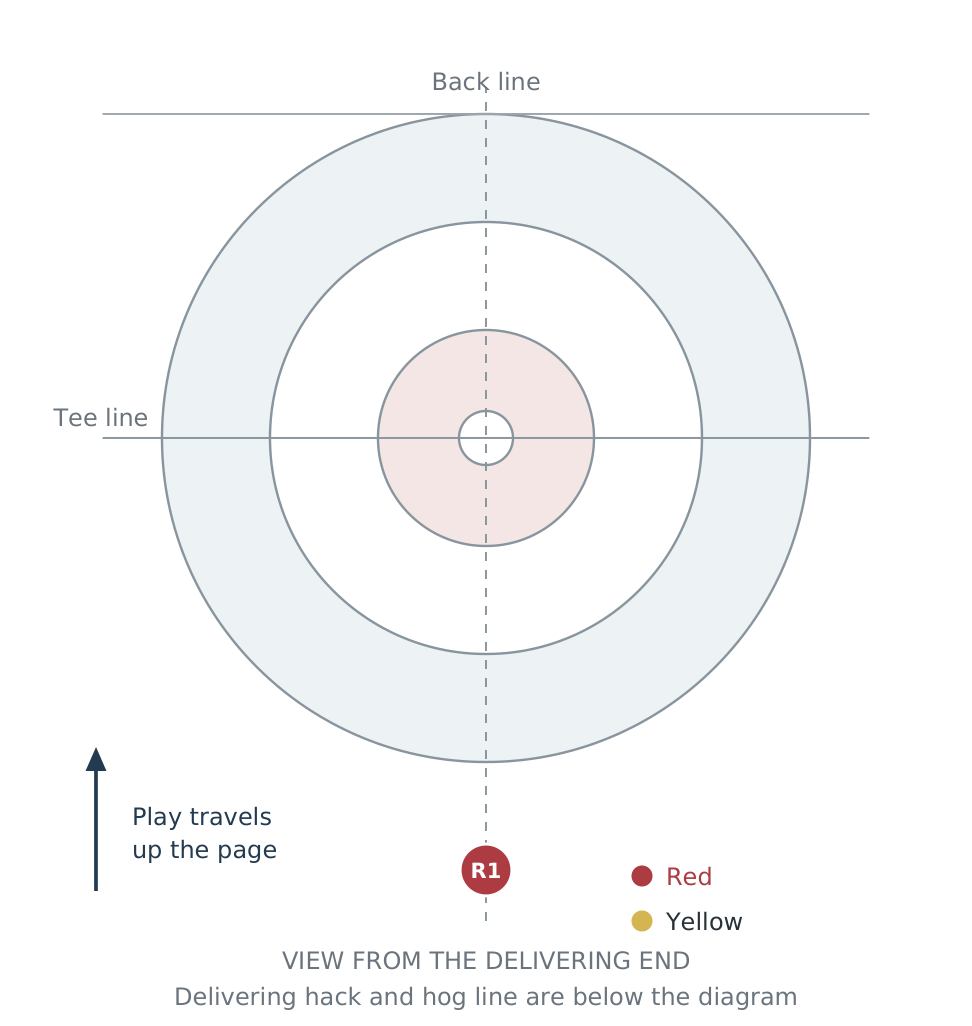
A. The early centre guard
Score: 0–0 · End: 2 of 8 · Hammer: Yellow
Yellow plays stone 2. The first end was blank. Only R1, a centre guard, is in play. Eight Yellow and seven Red stones remain, including the stone about to be played.
Exact stone positions
R1: on centre line, 8 feet in front of the tee line
Compare these options
Draw around R1 to start a central scoring position.
Place a corner guard to develop another route.
Attempt a controlled tick, keeping R1 in play.
Talk it through: Which choice fits your lead’s tested shots today? Compare a useful short draw with a failed tick that leaves the centre blocked. Removing R1 now breaches five-rock protection; the wheelchair no-tick exception does not remove that protection.
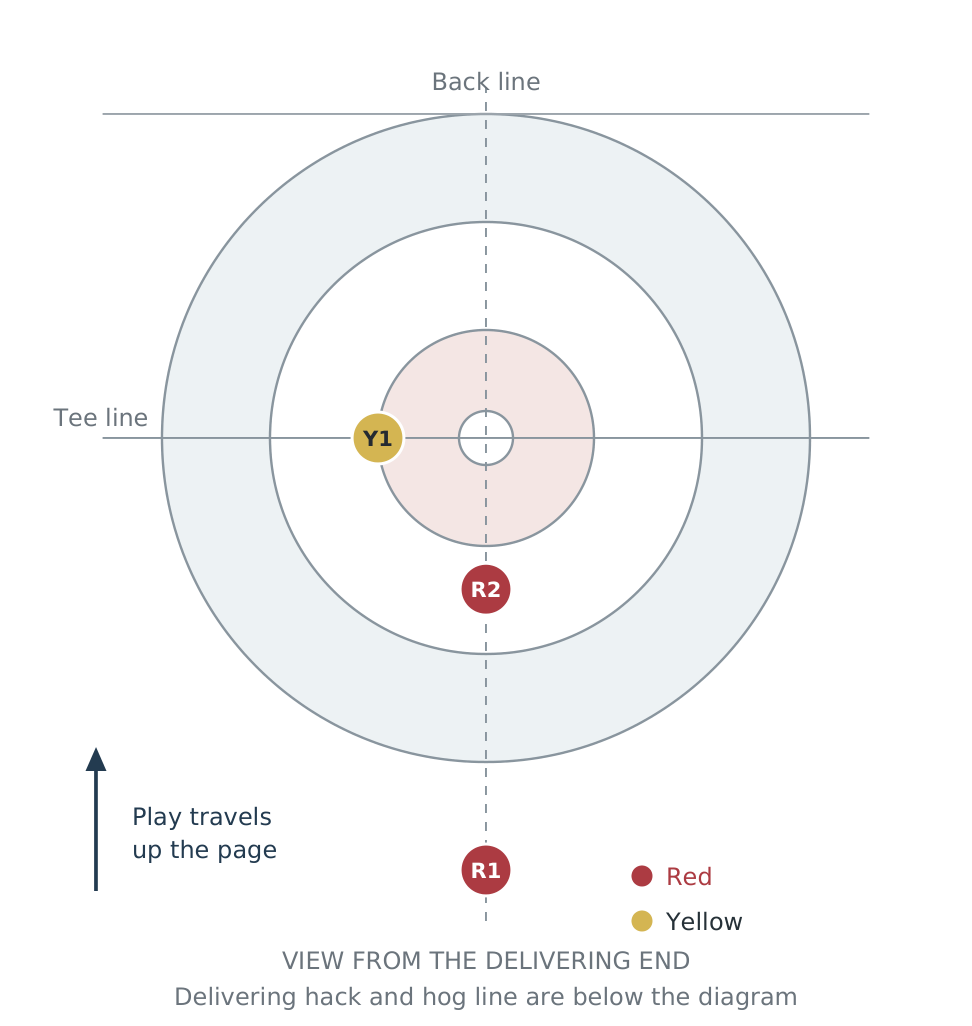
B. Build two or open the centre?
Score: 3–3 · End: 5 of 8 · Hammer: Yellow
Yellow plays stone 12 and lies one. Three Yellow and two Red stones remain. All other delivered stones are out of play.
Exact stone positions
R1: on centre line, 8 feet in front of the tee line
R2: on centre line, 2.8 feet in front of the tee line
Y1: 2 feet left of centre line, on the tee line
Compare these options
Draw to the open right side of the four-foot, closer than R2, to lie two.
Remove R1 to open the centre for later shots.
Talk it through: How well is that draw path known? Which Red reply concerns you: a hit on Y1, a runback or a replacement guard? Choose a useful miss and explain how you will still pursue two with the remaining stones.
Let the score change the choice
Fictional discussion positions. View from the delivering end; play travels up the diagrams. All unlisted delivered stones are out of play. Labels identify stones, not delivery sequence. Remaining stones include the next delivery.
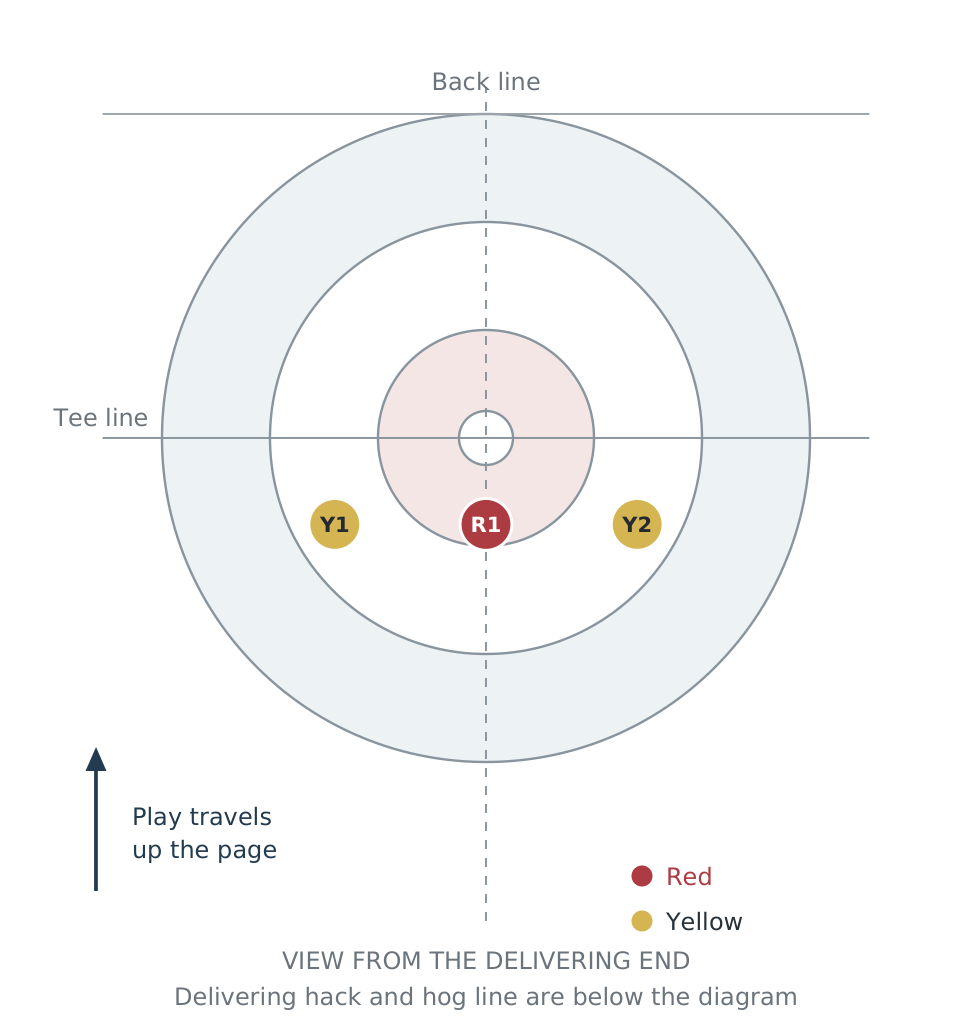
C. Protecting a two-point lead
Score: Red 6, Yellow 4 · End: 8 of 8 · Hammer: Yellow
Red plays stone 15 and lies one. One stone remains for each team. All other delivered stones are out of play.
Exact stone positions
R1: on centre line, 1.6 feet in front of the tee line
Y1: 2.8 feet left of centre line, 1.6 feet in front of the tee line
Y2: 2.8 feet right of centre line, 1.6 feet in front of the tee line
Compare these options
Guard R1 to make Yellow’s removal harder.
Remove one Yellow counter and try to leave the shooter closer than the other.
Draw another Red counter nearer the button than both Yellow stones.
Talk it through: Trace Yellow’s best realistic final reply to each choice. A guard that leaves a usable removal route could allow a big score. A hit that rolls out may fail to limit the danger. Which plan gives your team the best chance to prevent two? No option guarantees the result.
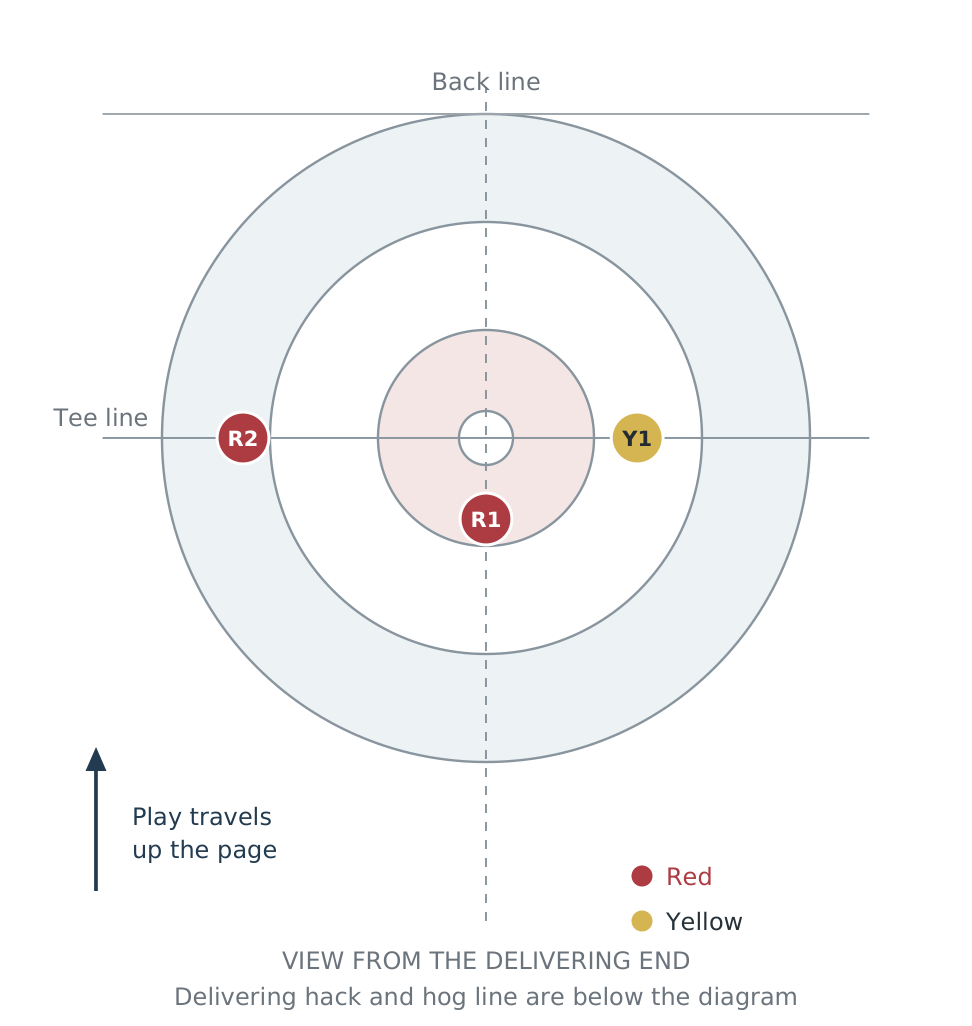
D. One to tie, two to win
Score: Red 6, Yellow 5 · End: 8 of 8 · Hammer: Yellow
Yellow has the last stone. Red lies one. All other delivered stones are out of play.
Exact stone positions
R1: on centre line, 1.5 feet in front of the tee line
Y1: 2.8 feet right of centre line, on the tee line
R2: 4.5 feet left of centre line, on the tee line
Compare these options
Draw closer than R1 for one point and a tied game.
Remove R1 and retain the shooter closer than R2, with Y1 unchanged, for two and the win.
Talk it through: Compare today’s draw and hit-and-stay evidence. If R1 is removed but the shooter rolls out, Y1 alone scores one. Missing R1 entirely may lose the game. What change in player confidence or ice knowledge would change your call?
Practise the decision, not only the shot
Tabletop: two teams, one position
Choose a scenario. Before anyone argues for a shot, each person privately names the end goal and two options. Discuss one likely opponent reply and one costly miss for each. Let the player who would deliver describe which path and weight they trust today.
Mark the intended finishing area or contact point, not just an arrow to the button.
Pick the team’s call and a reason. Move a token to a plausible miss and decide what changes.
Change one condition: the score, stone count, known ice path or delivering player. Discuss whether the call changes.
On-ice: useful-area practice
With your coach and normal rink procedures, select a shot from your current repertoire. Name the desired finish and the larger area that would still serve the tactical purpose. Repeat it on a chosen turn and path without sweeping. Record all outcomes, including misses. Test the other direction of play separately.
Keep a simple tally of useful, partly useful and harmful results, with a short reason for each. Agree those definitions before the trial. The tally describes this practice sample, not a universal success probability.
On-ice: compare two options
Re-create one fictional position in practice. Compare two legal calls using the same player and a consistent setup. Reset between trials. After each result, identify the opponent’s strongest realistic reply. A shot can hit its target and still be the weaker tactical choice.
Debrief without hindsight
Before: what did we expect, and what evidence supported the choice?
After: what actually happened to line, depth, contact and score potential?
Separate: was the issue the decision, the call, execution, the ice read, or still unknown?
Carry forward: what one observation should the next player know?
The aim is better shared decisions. A well-chosen shot can miss; a poor choice can work. Keep both the original reasoning and the actual outcome in the discussion.
Our next-shot worksheet
The printable guide includes a blank house and space to record score, end, hammer, stones remaining, two options, likely replies, the chosen call, useful miss, expected result and actual outcome.
Rule notes checked against World Curling’s October 6 revision of the 2026 rules, effective 1 September 2026, on 10 October 2026. The linked rules page is the place to check future updates. Competition-specific rules take priority.
For the discussion leader
Invite wheelchair curlers to describe their own shot choices and experience. Let players disagree about the scenarios when they can explain the evidence and tradeoffs. The diagrams specify positions, not exact curling paths. No single call is presented as universally best.
Draw: a shot intended to finish in the house. Guard: a stone in front that helps protect or shape access. Takeout: a shot intended to remove a stone. [2]
Force: leave the opponent with hammer taking only one. Steal: score without hammer. Blank: neither team scores; see the scoring explanation in source 2.
Useful miss: HouseCall’s plain-language prompt for an imperfect result that still helps the plan. It is not an official rule term.
Take it to practice
Download the printable guide for worked examples and reusable worksheets. Clubs may download, print and share it for noncommercial educational use. Keep the credit to Mary Deuhs and HouseCall. Not for resale.