Stopwatch timing
Choose an interval, use the same reference points and calibrate against real finishes.
Download timing guide · PDF
One stone. A shared conversation.
Start with steady feet and a flat brush. Build toward better calls, timing and team decisions.

Choose an interval, use the same reference points and calibrate against real finishes.
Download timing guide · PDFConnect the thrower’s release, the sweepers’ weight estimate and the house’s line call.
Download communication guide · PDFUnderstand what affects the result, what to test and why old recipes need checking.
Download sweeping guide · PDFStart with steady feet
You do not need to sweep hard on your first try. Begin with an instructor, a clear practice area and a pace that feels comfortable. These six steps build toward following a slow stone. Move on when you feel ready.
Use clean, secure grippers on both feet, including a gripper over your slider. Ask your instructor to check the fit, footwear and brush. Start without a moving stone.
Try it: Take a few small steps, stop, then change direction slowly. Tell the instructor if either foot slips. Fix the problem before adding sweeping.
A useful starting grip divides the handle into thirds: lower hand about one-third up, palm down; upper hand farther up, palm up. Keep knees softly bent. Let your instructor adjust the spacing for you.
Try it: Hold the position briefly, then relax. You should be able to look ahead and speak without feeling twisted or stretched.
Keep the pad flat and make short, controlled back-and-forth strokes. Start slowly with light pressure. Avoid tipping onto the brush edge.
Try it: Make five steady strokes while standing still, then rest. Ask your instructor to watch the pad. Repeat at the same speed until the movement feels smooth.
Move beside the stone’s intended path with short, controlled steps. Look ahead for stones and people. Practise footwork before combining it with brushing.
Try it: Travel a short distance without a stone, stop and reset. Add gentle strokes on the next pass. Keep the distance short enough to finish with good control.
Sweep ahead of the moving stone, leaving enough clearance to avoid touching it. Give your partner room. Ask your instructor to set safe positions and a manageable stone speed.
Try it: Follow one slow practice delivery. If you fall behind, stop sweeping and move clear on your own side. You can reset for another attempt; there is no need to chase.
Agree what “sweep” and “off” mean before starting. Sweepers report likely finishing distance, or weight; the skip watches line.
Try it: Have the instructor call one start and one stop during a slow shot. Say where you think the stone will finish, then compare your estimate with the result.
Try two stationary brushing rounds, two short moving passes without a stone and three slow deliveries. Rest between turns. After each attempt, choose one thing to improve. If footing, comfort or clearance breaks down, return to the previous step with your instructor. Practise from the other side only when the instructor says you are ready.
Technique reference: Curling Canada’s Discover Curling, brushing sections. The practice routine above is a HouseCall suggestion to adapt with your instructor.
Make each repetition useful
Start here once you can follow a stone comfortably, keep the pad controlled and respond to calls. Work with a coach to improve repeatability. Greater effort is useful only while your footing, movement and awareness remain steady.
Ask your coach to watch a short sweep and choose one focus: steadier pressure, smoother stroke speed or more reliable pad contact. Write down the cue in a few words. Trying to change everything at once makes it harder to tell what helped.
Try three short rounds at a comfortable pace, resting between them. Have the coach watch whether your final strokes remain controlled. Increase either pressure or stroke speed a little, then reassess. If the pad tips, your feet slip or you lose sight of your path, reduce the effort and reset.
Before a practice draw, agree on a target, an acceptable miss and who resolves competing calls. Rehearse a situation where the sweepers think the stone is short but the house wants more curl. Practise a clear weight update, a clear decision and an immediate response. Discuss the decision after the stone stops.
Choose one marked start point for a set of comparable practice shots, then test another. Record when sweeping actually began and ended. If using a stopwatch, keep the interval and reference edges consistent. Treat the reading as one clue: different releases and changing ice can produce different finishes from similar times.
World Curling’s September 2026 policy prohibits techniques intended to slow a stone, side-only or edge-only contact and push-dominated single strokes, even when the brush stays down during the return. Deliberately depositing debris is also prohibited, as is making a stone fall back against its turn significantly beyond the effect of existing ice conditions. Confirm your event’s equipment and technique requirements before testing any unfamiliar method.
Ask a coach to select one permitted change. Compare repeated baseline shots with repeated test shots, keeping the turn, delivery and line as similar as practical. Record the pad, sweeping interval and finish. A left-side or right-side position alone is not a reliable steering instruction. Treat any useful pattern as conditional on that setup.
Try three baseline deliveries and three test deliveries, alternating between them. Record distance and line separately. Flag obvious delivery differences rather than hiding them. Review the whole set with your coach, then choose whether to repeat, simplify or drop the change. When results are mixed, write “inconclusive.” A safe, repeatable retry teaches more than forcing a result.
Check the World Curling sweeping technique policy, September 2026. It applies at World Curling championships and events; ask which provisions your club or competition uses. These practice routines are HouseCall suggestions, not guaranteed performance formulas.
Say where it will stop
Some teams use numbers to describe a stone’s predicted finishing depth. These are target zones, not seconds on a stopwatch and not a scale of sweeping effort. Agree on your team’s map before the game.
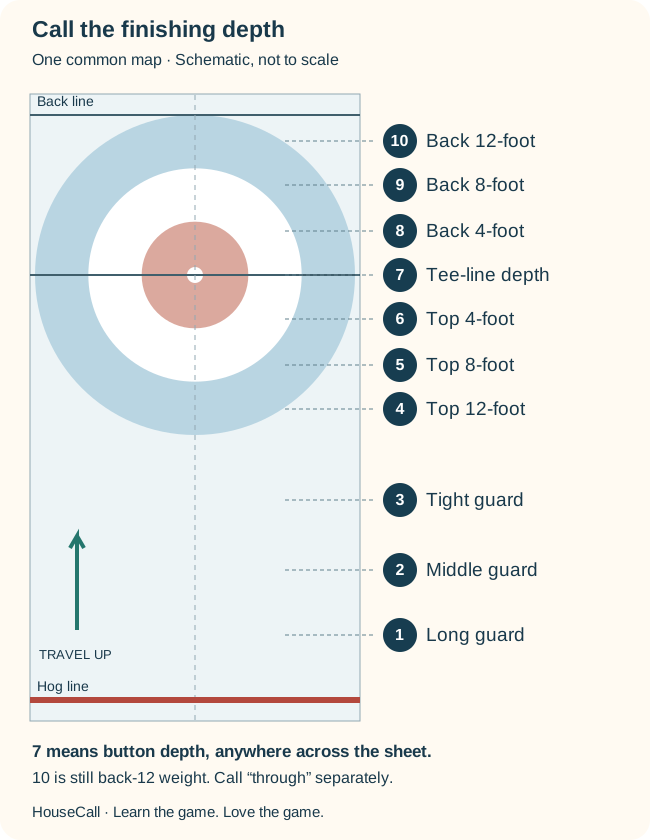
A sweeper might call “Five,” then “Six now” as the stone’s speed becomes clearer. The skip combines that depth estimate with the line. If the numbers cause confusion, use a place name such as “top eight” instead.
Simple practice: Pick a target zone, call an early estimate, update it later and compare it with the actual finish. Talk about the miss without treating one early number as a promise.
Published examples: Club de curling Laval glossary and John Rudd and Sean Turriff’s Curling Drills Handbook, “In the Zone,” printed page 26. Team conventions and zone boundaries can vary.
A clue, not a command
Time from the delivery-end back line to the delivery-end hog line. This short split gives an early clue about delivery speed.
Time between the two hog lines. This is a different interval, so its numbers cannot be compared directly with the short split.
Use the same stone edge and the same edge of each painted line every time. Write down the convention before comparing readings.
Human reaction and viewpoint affect readings; hundredths on the display are not proof of hundredth-second accuracy. Timing must not distract from stable footing or watching where you are moving.
Coaching background: Curling Canada, Discover Curling, timing section. A team’s edge convention is a consistency choice, not a universal official timing rule.
Watch HouseCall’s stopwatch Short →Give each other useful information
Agree target, turn, weight and an acceptable miss. Confirm who calls line while the skip throws.
The thrower reports the release feel. Sweepers estimate the finishing area and update it as the stone travels.
The skip or acting vice reads line and resolves competing line and weight priorities. Share changes early.
“Top four” or “back eight” tells teammates where you think the stone will finish. If your team uses numbered zones, agree on the 1–10 map first. A split time alone does not tell everyone the same story.
Thrower: “A little light.”
Sweeper: “Top twelve… now top four.”
House: “Line is good. For weight.”
Sweeper: “Tee weight now.”
This is an example conversation, not a fixed script. Corrections are useful information.
Use comfortable draw weight. Agree who gives the main weight update and who watches line. After each shot, ask whether the calls were early, clear and useful. Describe what changed without blaming the person who noticed it.
Sources: Discover Curling, communication section and Curling Canada’s Getting Started manual.
Eight interactive challenges: read the turn, move the brush, choose a goal and compare practice records.
Play the sweeping gameInfluence is not a guarantee
Sweeping can influence distance and curl. A sweeper’s side alone does not determine the result. Rotation, stroke angle, where the brush crosses the running path, pad construction, pressure, speed and ice all matter.
Begin with balance, safe movement and normal sweeping. Advanced changes need coaching and checks against the rules used at your event.
These guides do not offer a universal “stand left to curl more” recipe. A controlled study or elite technique may not transfer to your pad, ice and delivery.
Research: Sonobe and colleagues, Sports Engineering (2024). Current technique limits: World Curling, Statement of Principles, September 2026.
Technique and permission are different questions
Under World Curling’s four-player rules, only one player from each team may sweep behind the playing-end tee line. On the delivering team, that may be any player; on the non-delivering team, only the declared skip or vice-skip may do so. An opponent’s stone may be swept only behind that tee line and only after it reaches the line. Your team has first privilege to sweep its own stone, without obstructing an opponent.
Mixed doubles allows either or both players to sweep their delivered stone and their own stones set in motion in front of the playing-end tee line; the behind-tee limit still matters. Do not transfer a rule from one format without checking.
Read World Curling Rules R8 and R17 (effective 1 September 2026). World Curling’s policies apply at its championships and events; other competitions may adopt them. Ask your club or organizer which rules apply.
Sources checked October 2026. Coaching explanations are educational guidance, not a substitute for your event’s rules or on-ice instruction.